
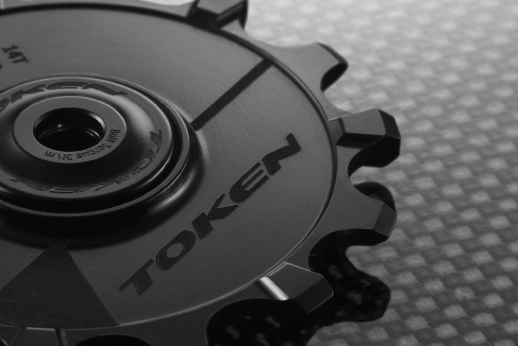
I’ll be the first to admit I was late to Token. For years, I was deep in the world of direct-from-China brands. I was convinced I’d mapped the entire territory of value-for-money Asian carbon. Then a training partner rolled past me on an event with a set of wheels I didn’t recognise. That hub sound, smooth, almost whisper-quiet, caught my attention before anything else did. Token Cycling. Founded in Taichung, Taiwan in 2002, Token has spent over two decades quietly building a reputation among triathletes, endurance riders, and the kind of obsessive component nerds who actually read bearing specifications for fun (guilty). This Token cycling brand review is long overdue. If you’ve been sleeping on these wheels and components, it’s time to wake up. Token is just one of the most underrated names in serious cycling performance. Check out the full range directly on Token’s official website before we dive into my Token Cycling Brand Review.
Born in Taichung: The Token Origin Story
Token was founded in 2002 by James Chang, a mechanical engineer with nearly three decades of experience in the cycling industry before he decided to build something of his own. That background in engineering isn’t just a marketing footnote. It fundamentally shaped what Token became. Where a lot of brands start with a frame or a wheel and work outward, Token began from the inside: bearings.
The humble bearing. Not glamorous, not Instagram-worthy, but arguably the most critical interface in your drivetrain and wheel system. Token’s TBT and TFT bearing series built the brand’s early reputation for precision manufacturing, and that same obsession with mechanical refinement defines their entire product philosophy today. This is a brand built by an engineer who understood that the most important parts of a bicycle are the ones you never see but feel on every single pedal stroke.
Based in Taichung, the heartland of Taiwanese cycling manufacturing, a city that basically exists to produce exceptional bicycle components, Token operates in the same ecosystem that gave the world some of the most respected OEM suppliers in cycling history. The name itself sums up their philosophy perfectly: Token means the weapon you hold to win the game. Two decades later, they’re still sharpening that weapon.
“Passion, Innovation, Craftsmanship.” That’s their tagline. In my experience, brands that need to say this loudly are often the ones that don’t deliver. Token is the exception. The proof is in the products and in the bearings.
What Token Actually Makes — The Full Product Range
Zenith Series Wheels — The Flagship Line
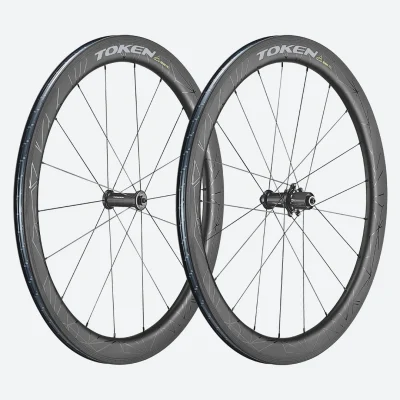
Token’s top-of-line Zenith series is where the engineering ambition is most visible. The two headline road wheelsets are the Ventous (36mm depth, 1,342g) and the Konax Pro (52mm depth, 1,452g), and between them you get a clear picture of what Token stands for.
The Konax Pro is the one that stops conversations. Named after the IRONMAN Kona World Championship, Token’s triathlon heritage showing through, it’s a 52mm deep carbon wheelset tipping the scales at 1,452g for the pair. That’s genuinely competitive territory: lighter than most stock factory wheels and within striking distance of boutique brands charging twice the price. The specs are not messing around:
- 52mm rim depth, 27.4mm external rim width
- 18 front / 21 rear Sapim CX-RAY spokes — not an upgrade, this is standard
- Z1 hubs with 5-axis CNC machined precision
- TFT hybrid ceramic-stainless bearings
- Tubeless ready, UCI approved
- 3-year warranty plus crash replacement policy
CFD (Computational Fluid Dynamics) went into the Swiftedge rim profile. Token uses the same aerodynamic analysis software that wheel brands spending far more on R&D claim as their secret weapon. The result is a rim shape optimised for crosswind stability despite the 52mm depth. Reviewers and riders consistently note it handles gusty conditions better than the depth would suggest.
The Ventous at 36mm is the climber’s pick and, frankly, the year-round sensible choice for most of us. At 1,342g it’s lighter than the Konax Pro while still offering a meaningful aero advantage over shallow alloy wheels. For variable Belgian weather and mixed-surface endurance events, this is the wheel I’d reach for first.
Prime and Resolute Series — The Rest of the Range
Below the Zenith flagship sit the Prime and Resolute series, covering a seriously wide spread: gravel (RoubX, 33mm, 1,568g), mountain bike (Conquer Boost), alloy road options, and the C45D/C45R carbon road wheelsets at 44.5mm depth. The C45R at 1,555g hits a sweet spot between aero and weight that makes mainstream brands uncomfortable at its price point.
The Resolute wheels are Token’s entry into the value segment without abandoning the bearing and hub quality that defines the brand. You’re still getting TFT bearings, still getting tubeless-ready rims, still getting the 3-year warranty. That consistency across the range is rare.
Beyond Wheels — Where Token Really Sets Itself Apart
Here’s what separates Token from most wheel brands: they make the whole drivetrain interface. Their Ninja Bottom Bracket and Shuriken Oversized Pulley System (OSPD) have genuine followings among the weight-weenie and performance-efficiency crowd.
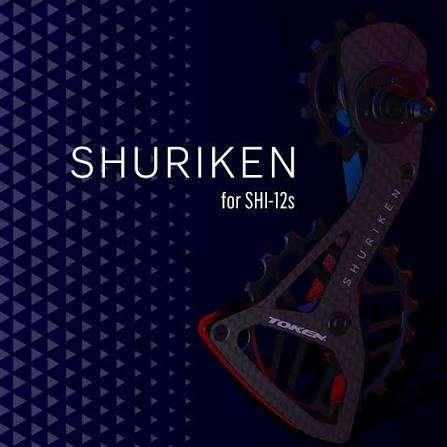
The Shuriken OSPD is a derailleur upgrade that reduces drivetrain friction through larger pulley diameter and, naturally, Token’s premium ceramic bearings. It’s the kind of upgrade that’s hard to quantify on a single 60km training ride but compounds dramatically across 30,000 kilometres of annual riding. As I explored in my look at Farsports and how Asian brands engineer differently from Western counterparts, the smartest brands in this space often win through precision in the details nobody’s advertising. Token is a textbook example.
Token Cycling Brand Review Real-World Performance — What I Found After Thousands of Kilometres
Let me be direct: I’ve put these wheels through conditions most cyclists would never consider voluntary. Belgian roads are not kind to equipment. We have cobblestones, cracked asphalt, farm tracks connecting the long flat stretches, and enough road surface variation to destroy a poorly built wheel inside a single 300km brevet. When I say a wheel held up on Belgian roads, I mean it genuinely held up. No developing spoke tension loss, no ghost creaks appearing at hour eight, no that-slightly-off-true feeling that creeps in from cheaper builds after six months of hard use.
The Token Konax Pro I ran through an extended block of ultra-distance training and events never gave me cause for concern. The TFT hybrid bearings rolled with a consistency I associate with Swiss-made hubs costing significantly more. That smoothness isn’t just a luxury for ultra-distance cycling. It’s pure efficiency. Every watt of friction tax compounds over 600km. The hub that rolls with less resistance at the 3% incline at hour eighteen is the hub that genuinely matters.
Crosswind handling
The 52mm depth was occasionally a conversation in crosswinds, particularly on exposed stretches of flat Belgian countryside where the wind can decide to rearrange your afternoon, but Token’s Swiftedge profile genuinely handled it better than I expected. I’ve ridden deep wheels from well-known Western brands that felt more nervous in gusty conditions than the Konax Pro did. At speeds under 40km/h into headwinds on a 300km route, that stability is not a small thing.
Tubeless setup was completely hassle-free. They sealed on first inflation, ran comfortably at 60psi with 28c tyres for endurance events, and provided that extra compliance layer that makes a real perceptible difference on the second 300km of a long ride. In my experience riding 600km non-stop, the difference between a wheel that soaks up road feedback and one that transmits it directly into your hands and sit bones is the difference between finishing and not finishing.
The Ventous 36mm remains my personal recommendation for anyone covering serious long-distance in variable conditions. The weight advantage and lower crosswind sensitivity make it the more versatile tool. At 1,342g you’re not sacrificing any meaningful aero gain for mixed-condition parcours, and in ultra-distance terms, where nobody is averaging over 60km/h for twelve hours, the weight and stability win every time.
Token Cycling Brand Review – Value for Money — The Token Proposition
No honest token cycling brand review with some honest maths. Zipp 303 Firecrest: around €1,600–2,000. Enve SES 3.4: more. DT Swiss ERC 1400 Dicut: around €1,400. All genuinely excellent wheels. All carrying brand name premiums that have nothing to do with the actual carbon layup or bearing quality inside.
Token Konax Pro lands in the €550–750 range depending on source and currency. For what you are getting UCI-approved race wheels, Sapim CX-RAY spokes as standard, TFT bearings, 1,452g total weight, full tubeless compatibility, a 3-year warranty with crash replacement, that price represents extraordinary value. Not “for what it is” value. Actual, objective value.
The ultra-cycling community tends to be more pragmatic about gear than the race-day-only crowd. When you are riding 500km across the Pyrenees or grinding through a 24-hour challenge, reliability and rolling efficiency per euro spent matter more than whether your wheels photograph well at the race start. Token understands this audience intuitively. It is baked into their triathlon and endurance DNA.
Where they sit in the market: comfortably above budget Aliexpress-tier components (a category that serves a purpose but carries real uncertainty on consistency and safety), and meaningfully below the Western premium tier. They occupy the same intelligent middle ground as Farsports, Silverbell, and Superteam, but with the added credibility of a physical Taichung-based operation with genuine engineering pedigree, established international dealer network, and real parts availability. The ultra-cycling community often overlooks these brands, in Token’s case, that is a significant mistake. That’s something I really wanted to make clear in this Token Cycling Brand Review
Token Cycling Brand Review – How Token Compares — Pros, Cons, and the Competition
Token vs. Farsports: Farsports offers far more customisation. You can specify almost any combination of hub, rim depth, spoke count, and finish. Token is a more standardised production experience but with arguably more consistent quality control and significantly better warranty and dealer support infrastructure. Both are excellent. The choice comes down to whether you want bespoke or reliable production-line precision.
Token vs. Superteam: Superteam edges Token on pure price at the entry level. You can get a Superteam carbon wheelset for under €300. Token wins decisively on bearing quality, brand heritage, engineering pedigree, and the overall package. For serious endurance use over multiple seasons, Token is worth the premium.
Token vs. Western premium brands: At 50–60% of the price for equivalent weight and performance data, Token makes a case that is genuinely difficult to dismiss. The Western brands retain advantages in local dealer support, racer cache, and (sometimes) faster warranty resolution in certain markets. For the performance-focused endurance cyclist who doesn’t need the logo, Token is a fully legitimate alternative. It is not a compromise.
Pros:
- Exceptional bearing quality — TFT hybrid ceramic-stainless as standard
- Genuine engineering pedigree from Taichung since 2002
- Sapim CX-RAY spokes included as standard across flagship models
- UCI approved and race-ready
- 3-year warranty plus crash replacement policy
- Full product ecosystem: wheels, bottom brackets, pulleys, hubs
- Strong value versus Western premium brands at equivalent performance
Cons:
- Less customisable than some direct-from-China competitors
- Brand recognition still limited versus big Western names in some markets
- Local dealer servicing can be difficult to find in certain regions
- Valves not always included despite full tubeless readiness
The Verdict — Should You Choose Token?
Token is the kind of brand I want more people in the ultra-cycling community to discover. This Token Cycling Brand Review should be the next step to help them increase brand visibility. They have been doing precision engineering since 2002, they build their bearings better than most brands build their entire hubs, and they price their products at a level that genuinely makes you question why you would spend more. This Token cycling brand review only scratches the surface. Their Shuriken pulley system and Ninja bottom bracket line are worth a deep dive in their own right for anyone serious about drivetrain efficiency.
Belgian roads will keep testing my equipment honestly, and Token has passed everything I’ve thrown at it. If you are building a serious endurance bike, upgrading wheels for long-distance events, or just tired of paying Western brand premiums for components that Token matches at a fraction of the price, put Token on your shortlist. You won’t regret it.
Have you tried Token Cycling gear? Drop a comment below. I’d love to hear your experience.
