

The first time I heard the word “brevet,” I was deep in a Ventoux training block, wondering whether there was something bigger to chase after a single mountain. Brevet cycling culture, the global world of randonneurs, brevet cards, and rides stretching from 200 to 1200 kilometres with nothing but your own legs and a stamped card to guide you, is one of the best-kept secrets in endurance sport. It was there long before Strava, before organised gran fondos with finisher medals and feed stations every 30 kilometres. And it is thriving more than ever. In this article I am going to tell you everything you need to know about brevet cycling culture: where it comes from, what a brevet actually feels like from the inside, and why I consider it one of the most honest, addictive forms of cycling on the planet. Whether you are a weekend rider curious about your first 200 km or a seasoned ultra-distance athlete thinking about qualifying for Paris-Brest-Paris, this one is for you.
Understanding Brevet Cycling Culture — History and How It All Works
The word brevet is French for “certificate” or “diploma”. And that is exactly what you receive when you complete one. Brevet cycling culture traces its roots back to the late nineteenth century and is formally governed today by the Audax Club Parisien (ACP), the Paris-based organisation that certifies brevet results worldwide. Every country has a national affiliate. In Belgium the regional clubs coordinate under the wider ACP umbrella; in the UK it is Audax UK; in the United States, RUSA. The spirit, however, is universal and immediately recognisable the moment you line up at your first start.
A brevet is a long, timed, self-supported cycling challenge. Self-supported means no follow cars, no personal feed zones, no team mechanic waiting at a van. You carry what you need, or source it along the route at shops, cafés, and petrol stations. Timed means there are cut-off limits. It are generous ones, calibrated around a 13–15 km/h rolling average including all stops. But miss a cut and your card goes unstamped, and the ride becomes unofficial. There is no finish-line tape, no winner’s podium, no points competition. Everyone who finishes gets their name on the same list, in alphabetical order. In a world drowning in Strava segments and podium chases, that alphabetical list feels almost radical.
Brevet Distances Explained: From 200 km to the Monster 1200
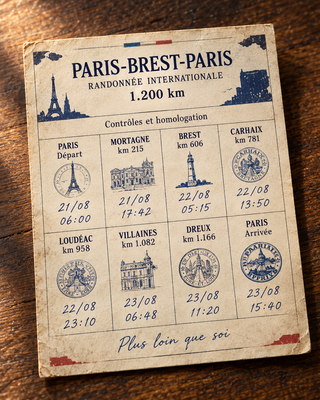
The Audax Club Parisien recognises six standard brevet distances: 200 km, 300 km, 400 km, 600 km, 1000 km, and 1200 km. To earn the coveted SuperRandonneur medal in a single season, you complete the first four: 200, 300, 400, and 600 km, each as a separate, separately certified event. These rides accumulate across the brevet season, which typically runs from January to October. It is a long game, and that is precisely the point. The 1200 km distance is reserved for the grandest events, most famously Paris-Brest-Paris, held every four years, for which you must qualify by completing a full SuperRandonneur series in the qualifying year. Over 6000 riders from around the world line up at the start. It is the holy grail of brevet cycling culture.
What Sets Brevet Cycling Culture Apart from Racing and Sportives
Here is what surprises almost everyone when they first step into brevet cycling culture: there is no competition. None. You are riding against the clock, and against yourself, but not against the person next to you. Riders who are faster will often slow down to help a companion who is struggling. Experienced randonneurs will share a café table with a complete stranger at 3 in the morning, trading stories over something warm. I have been in some very dark places on long rides, and there is something uniquely powerful about the brevet ethos: everyone out on that road shares a secret understanding of what it takes to keep going when the rest of the world is asleep.
Compare this to a gran fondo, which is a wonderful thing but ultimately a carnival. Feed stations every 20 km, thousands of riders, timing chips, and a finisher jersey. Or compare it to ultra-racing like the Transcontinental Race or the Race Around Belgium, where strategy, route planning, and fierce competition are central. Brevets sit in a space of their own: structured enough to give you a goal, free enough to let you ride entirely on your own terms.
The Brevet Card and the Control System
The brevet card, or carnet de route, is your proof of passage. At each control point (a checkpoint, usually a café, bar, petrol station, or grocery shop, spaced roughly every 50–100 km along the route), you get the card stamped or collect a dated receipt. Miss a control and your ride is unofficial. It sounds bureaucratic, but that little card becomes enormously precious somewhere around hour eighteen on a dark Belgian road. It is proof you were there. Proof you kept going. Proof you earned every single kilometre.
The time limits are set so that a rider averaging around 13–15 km/h including all stops will finish comfortably within the window. But “comfortable” is relative. On a 400 km brevet you will ride through at least one full night. On a 600 km you might ride two nights with only a couple of hours of sleep between them. That is not comfortable by any ordinary definition. But it is transformative in a way that nothing else in cycling quite matches.

My Experience with Brevet Cycling Culture on Belgian Roads
Belgium is, I will say it plainly, one of the worst and best places in the world to do a long brevet. Worst because the roads, especially across the Ardennes, are a brutal mixture of cobblestones, potholes, and weather that can shift from sunshine to horizontal rain in the time it takes to eat a biscuit. Best for exactly the same reasons. If your bike, your tyres, your mental game, and your legs can survive a 300 km brevet across the Belgian hills, you are genuinely ready for anything the rest of the world can throw at you.
I have done long Belgian brevets on my Winspace T1550 Gen 2, which is my first-choice machine for events that demand both reliability and performance over many hours in the saddle. It handles Belgian road quality without rattling your fillings loose, while being aerodynamically fast enough that you are not bleeding time on the flat sections between the climbs. For ultra-distance brevets specifically, a bike that absorbs road vibration without sacrificing stiffness is worth its weight in gold. Your hands, neck, and sit bones will thank you at hour twenty.
If you want to understand my full programme of events for this season, including the longer monsters where brevet fitness is the foundation, I have laid it all out in my 2026 ultra-distance race and challenges calendar. Brevets are not just events in themselves; they are the best possible preparation for the bigger races.
Night Riding and the Brevet Mindset
One thing brevet culture forces you to do that no gran fondo ever will: ride through the night. Not once. Every 300 km-plus brevet involves darkness, and often a lot of it. There is something profound about riding alone through a sleeping Belgian village at 2 am, your front light carving a cone through the black, nothing but the sound of your tyres and your own breathing. You find out very quickly who you are when it is just you and the road.
My night-riding kit for brevets: a powerful handlebar-mounted light (minimum 1000 lumens, ideally 1500+), a solid rear light on a steady-flash mode, and, critically, a full backup set of both. On a 600 km brevet lasting 36 or more hours, a dead battery is a disaster that ends your ride. I always carry two front lights and two rears, plus a USB power bank for charging on the move. It’s one of those small logistical details that separates riders who finish from riders who do not.
Is Brevet Cycling Culture Worth It? Getting Started the Right Way
If you have never ridden a brevet, the most important thing I can tell you is this: start with 200 km. Not because it is easy, it is not, but because it is achievable on a solid base of fitness, it teaches you everything essential about self-sufficiency, and it gives you the bug to go further. Every randonneur I have ever met started with a 200 km and came back wanting more. That is the magic of brevet cycling culture in a nutshell.
Essential Equipment for Your First Brevet
For 300 km and above, ACP rules require certain equipment. In practice, I would carry all of this even on a 200 km:
- Lighting: front white light and rear red light. Non-negotiable even in summer, since start times are often pre-dawn
- Reflective vest or jacket: required by ACP rules for night sections; some organisers enforce this strictly
- Brevet card holder: a simple top-tube bag works perfectly; keep the card dry and accessible
- Basic repair kit: two spare inner tubes, tyre levers, mini pump, CO₂ canister, chain lube, multi-tool, a patch kit for emergencies
- Navigation: a GPS cycling computer with the route loaded is essential; carry a printed route sheet as backup
- Cash and a bank card: controls often require cash for café stamps; machine-readable receipts are the alternative
On a 200 km, most people can carry nutrition for the day in jersey pockets and a small frame bag. For 400 km and above, a proper bikepacking setup, or at minimum a generous saddle bag, becomes necessary.
Nutrition and Pacing — The Real Secrets
The golden rule of brevet nutrition is one I learned the hard way: eat before you are hungry, drink before you are thirsty. When you are in the zone at hour ten of a 400 km ride, it is the first thing your brain quietly stops doing. I now set a reminder on my GP. I eat something every 45 minutes, no exceptions. On 600 km-plus brevets this means consuming 5000–7000 kcal across the ride: real food at café controls whenever possible, gels and bars between them.
Pacing is equally non-negotiable. The single most common mistake beginners make is going out too hard in the first 50 km, burning through glycogen, and blowing up around the 150 km mark with 50 km still to go. I ride the opening quarter of any long brevet conservatively, power capped well below threshold, heart rate calm, and only open the throttle if I am genuinely feeling strong past halfway. It all started with a single decision to upgrade from the Cinglé to the Bicinglé du Ventoux. Six ascents of Mont Ventoux in one day. And the lesson was identical: the first ascent needs to feel almost too easy, or the sixth will break you.

How Brevet Cycling Culture Compares: Pros and Cons
Brevets occupy a unique space in ultra-distance cycling. Here is an honest comparison:
Versus gran fondos: Brevets are cheaper (entry fees typically €5–30), demand far more self-sufficiency, and are significantly harder. There are no feed stations every 20 km. You earn every kilometre.
Versus ultra-racing (Transcontinental, RAAM, Race Around Belgium): Brevets are non-competitive and far more accessible. The big ultra races require months of planning, a significant budget, and a high level of existing ultra-distance experience. A 200 km brevet you can enter this weekend with standard road cycling fitness.
Versus Everesting: Everesting is a single brutal vertical challenge. A brevet is about horizontal distance, navigation, and sustained self-sufficiency over time. Both are worth chasing; they develop completely different skills.
The real pros of brevet cycling culture: accessible for any fit cyclist; affordable; non-competitive and ego-free community; globally organised through ACP-affiliated clubs; outstanding preparation for longer ultra events. The cons: route quality varies significantly between organisers; the non-competitive format can feel low-stakes for riders who need a race to unlock their best; multi-day brevets of 600 km-plus require careful logistical planning around sleep, nutrition, and recovery that takes experience to execute well.
Frequently Asked Questions About Brevet Cycling Culture
What is brevet cycling culture and who is it for?
Brevet cycling culture is the worldwide community built around non-competitive, self-supported long-distance cycling events called brevets, governed by the Audax Club Parisien. Events range from 200 km to 1200 km, with generous time limits and a simple card-stamping system at checkpoints as proof of completion. It is for any cyclist who values personal challenge, self-sufficiency, and a genuinely supportive community over podiums and prize money. In my experience, it suits riders of all ages and abilities.
How long does it take to complete a brevet?
Time limits are set to require an average of approximately 13–15 km/h including all stops. A 200 km brevet typically allows around 13.5 hours; a 300 km allows about 20 hours; a 600 km allows 40 hours. Most experienced riders complete them faster, but the generous time windows make brevets accessible to anyone with a solid endurance base. You do not need to be a racing cyclist to finish one.
Is brevet cycling culture competitive?
No, and that is one of its greatest strengths. Brevet results list finishers alphabetically, not by finishing time. There are no rankings, no prizes, and no competitive standings. The ethos is entirely personal: you ride against the clock and against yourself. The community is remarkably supportive, with faster riders regularly helping slower ones through difficult sections rather than racing ahead.
What bike do I need for a brevet?
Any reliable road, gravel, or touring bike works. ACP rules allow all bike types. For longer brevets (400 km+), comfort becomes as important as speed. A bike with some compliance in the frame and fork, good tyre clearance for 28–32 mm tyres, and reliable lighting mounts will serve you far better than the lightest race bike in the bunch. Chinese carbon frames, brands like Winspace, Dengfu, and Trifox, offer an excellent balance of compliance and performance at prices that leave budget for quality components and lighting.
How do I qualify for Paris-Brest-Paris through brevet cycling culture?
Paris-Brest-Paris is held every four years and requires completing a full SuperRandonneur series, 200 km, 300 km, 400 km, and 600 km brevets, in the qualifying year (the year before the event). All four must be ACP-certified and completed within the same randonneuring season. For PBP 2027, that means completing your series in 2026 or the designated qualifying window. Registration for PBP itself typically opens after the qualifying series closes and fills extremely quickly.
The Bottom Line: Brevet Cycling Culture Is Worth Every Kilometre
Brevet cycling culture is one of the most genuine communities in endurance sport. No rankings, no prizes, no ego, just riders, the road, and the honest question of how far you can go. When I think about how my own ultra-distance journey started, that morning on the slopes of Ventoux when I decided to turn the Cinglé into the Bicinglé, six ascents in a single day, I recognise the same spirit in every randonneur I have ever met. Push a little further. See what is possible.
The brevet system gives you a structured framework for exactly that kind of self-discovery, from an achievable 200 km entry point all the way to the legendary 1200 km Paris-Brest-Paris. Brevet cycling culture rewards patience, self-awareness, and the willingness to keep pedalling when the rest of the world is asleep. In my experience, those are exactly the qualities that make someone an ultra-distance cyclist. And they are qualities that can be learned and developed, one stamped control at a time.
Start with 200 km. I promise you will come back wanting more. Have you ridden a brevet? Drop a comment below. I would love to hear your experience.
