
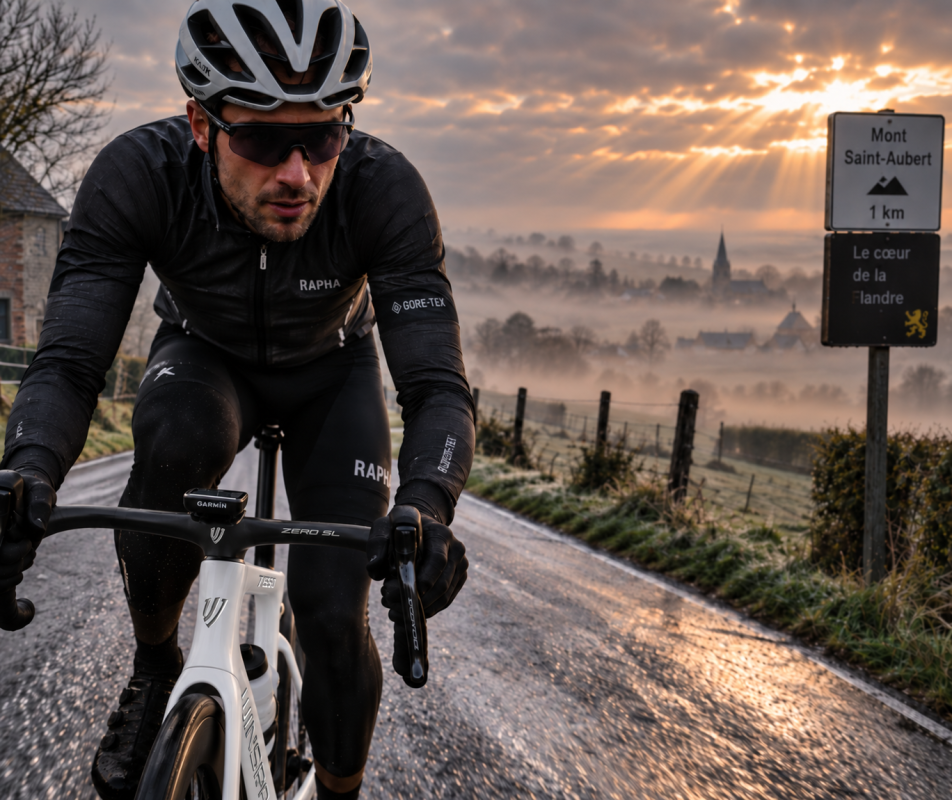
Let me paint you a picture. It’s 3 a.m., somewhere in the French Alpes, and you’re 380 kilometres into a solo overnight ride. You’re cold, your legs are running on autopilot, and the only thing standing between you and a wrong turn into a forest track is the little screen on your handlebars. In that moment, your GPS cycling computer for ultra distance isn’t a gadget. It is your lifeline. I’ve been in that situation more times than I care to count, and I’ve lost count of the number of devices I’ve burned through looking for the perfect companion for the long miles.
After completing events like the UBF Pyrénées 500, multiple Everestings, and my personal best of around 630 km in 24 hours, I have some strong opinions about which GPS computers genuinely work for ultra distance and which ones will let you down when you need them most. This guide cuts through the marketing noise. Bikepacking.com’s deep-dive on long-distance GPS use confirms a lot of what I’ve experienced firsthand, but I want to add the ultra-distance cycling perspective that most reviews completely ignore.
Why Your Regular GPS Computer Won’t Cut It Beyond 200 km
Most cycling GPS reviews focus on training metrics, Strava integration, and whether the touchscreen feels responsive. That’s fine for your typical 90-minute interval session. But ultra distance cycling operates in a completely different world, and the requirements are ruthless.
The number one issue is battery life. If your GPS dies at kilometre 280 of a 400 km brevet, you’re navigating by memory and hope. Most mainstream cycling computers claim 15–20 hours of battery. That might sound like a lot, until you’re running a 600 km brevet over 36 hours, riding through the night in low temperatures (which kills battery faster), with the screen on full brightness because you need to read your route in the dark.
The second issue is route reliability. Ultra distance routes are long, complex, and unforgiving. You’re often riding roads that wouldn’t appear in a standard Strava route. Narrow farm tracks in Belgium, switchbacks in the Pyrénées, remote mountain passes in the Alps. Your GPS needs to handle large GPX files, keep the route loaded reliably, and ideally offer some form of auto-rerouting when you miss a turn because your brain stopped functioning at hour 22.
And then there’s durability. Belgian roads are not kind to equipment, so when I say a device held up, I mean it. Three days of rain, mud, vibration from cobblestones, and sweat. Your GPS needs to take all of it without flinching.
The Top GPS Cycling Computers for Ultra Distance Riding
Here are the devices I’d actually recommend and one or two I’d steer you away from for the long stuff.

Garmin Edge 1050 — The Gold Standard
My personal gold standard for ultra distance riding is the Garmin Edge 1050, and I want to explain why. Because on paper, some of the numbers might make you hesitate. Standard battery life is rated at 20 hours, which sounds modest compared to some of the other devices here. But in extended battery-save mode, that figure climbs to 60 hours. More than enough to see you through a PBP, a Race Around Belgium, or any other serious ultra event. Besides I am combining it with a Ravemen FR500 front light which can also serve as an external battery allowing you to charge your GPS during the ride.
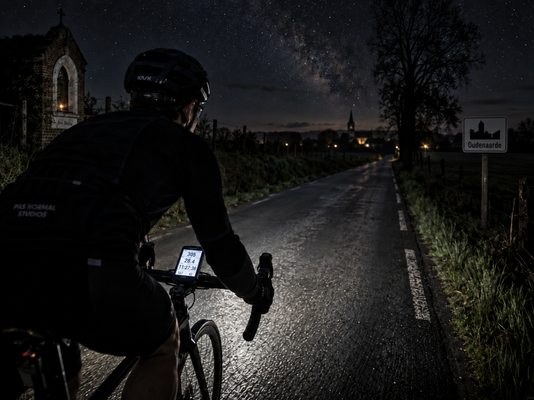
The real reason I switched to the Edge 1050 is the screen. Garmin moved to a transmissive LCD with a 480×800 pixel resolution, and the difference in brightness, contrast, and colour saturation compared to its predecessor is immediately obvious. When you’re riding through the Belgian countryside at 3 a.m. and you need to read your route at a glance without fumbling with backlight settings, this screen just works. It’s genuinely one of the best displays I’ve used on a cycling computer and for night-riding ultra athletes, that matters enormously.
Beyond the display, the Edge 1050 brings features that earn their keep in the real world: ClimbPro gives you gradient previews for every ascent on your loaded route; the crowd-sourced hazard alert system flags road obstacles reported by other Garmin users; GroupRide lets you track other riders in real time; and incident detection with live tracking are non-negotiable safety features for solo overnight riding. The improved processor keeps everything snappy. No waiting for maps to redraw when you miss a turn at kilometre 380 and need a quick reroute.
Route loading from Komoot, RideWithGPS, or Strava is rock solid. Large GPX files, we’re talking 600 km+ routes, load cleanly and stay loaded. No random hiccups, no vanishing waypoints, no drama. For an ultra cyclist who has experienced all of the above on lesser devices, that reliability alone is worth the premium.
At around €700 it’s the most expensive device on this list, and yes, the 20-hour standard battery means you’ll want a power bank on anything over 300 km if you’re not switching modes. But run it in battery-save mode for the overnight sections and keep screen brightness on auto, and the Edge 1050 will go the distance. It has on mine, every single time.
Coros Dura — The Battery Life Champion
The Coros Dura came out of nowhere and genuinely surprised me. This is Coros’s first dedicated cycling computer, and they went all-in on the one thing ultra distance riders care about most: battery life. The claimed figure is 120 hours of GPS usage. In real-world long-distance testing, users have reported covering over 1,200 miles on just two full charges across five months. That’s extraordinary.
The Coros Dura also adds solar charging, in direct sun, one hour of exposure generates up to two additional hours of ride time. During a nine-hour real-world test, the device lost just 3.5% net battery after solar gains. For a PBP, a Race Around Belgium, or a multi-day bikepacking adventure, this changes the equation completely.
At around €249, it’s also astonishingly good value. The interface is clean and simple, some would say too simple, and navigation relies on OpenStreetMap without topographic detail. Auto-rerouting is limited. But for riders who load their GPX route and follow it faithfully, the Coros Dura is arguably the best ultra distance GPS on the market from a pure battery-life-to-price ratio. I’ve recommended it to several friends who do long brevets on a budget, and the feedback has been overwhelmingly positive.
Hammerhead Karoo 3 — The Tech Enthusiast’s Choice
If mapping and navigation quality is your priority above all else, the Hammerhead Karoo 3 is extraordinary. It runs full Android, which means the maps are detailed, routing is smart, and the interface feels more like a smartphone than a traditional bike computer. The screen is beautiful, one of the best in the business for night-time readability.
The catch for ultra distance? Battery life hovers around 12–15 hours, depending on settings. That means for any event over about 200 km, you’re planning around a power bank. Plenty of ultra cyclists do exactly this, a small 10,000 mAh battery in the jersey pocket, charging the Karoo on the go. It works, but it’s an extra complication. The Karoo 3 earns its place on this list because its mapping is so good, but go in with eyes open about the battery reality.
Wahoo ELEMNT Roam V3 — The Navigation Purist
Wahoo has built its reputation on simplicity and reliability, and the ELEMNT Roam V3 delivers both. The setup is effortless, the app integration is smooth, and the turn-by-turn navigation is among the most intuitive I’ve used. Even at 3 a.m. when your brain is running at 40% capacity. Route loading from Komoot works seamlessly.
Battery life on the Roam V3 is around 17 hours, which puts it at the bottom of the ultra distance acceptable range. For a 300 km brevet you’ll likely get through with careful management. For anything longer, you’re either starting the event with a full charge and praying, or you’re carrying a power bank. Wahoo riders often do the latter with no complaints; the device charges fast and reliably. At around €379, it sits in a competitive mid-range bracket.
Bryton Rider 750 SE — The Budget Pick That Punches Above Its Weight
Not everyone has €700 to drop on a GPS computer, and that’s completely fine. The Bryton Rider 750 SE at around €199 offers 35–40 hours of battery life, solid navigation, good display quality, and full power meter and heart rate compatibility. For riders doing their first 300 km brevet or looking for a backup device, it’s a genuinely excellent choice. The ultra distance community often overlooks budget brands like Bryton, big mistake. The quality-to-price ratio here is exceptional.
Cycplus GPS — One to Watch (Beta First Look)
I don’t normally tease unreleased products, but I’ll make an exception here because this one genuinely has me excited. For the past few months I’ve been a beta tester for a brand-new GPS cycling computer from Cycplus. Yes, the same Cycplus who make the electric bike pumps I’ve been raving about for years. If you haven’t read my Cycplus pump review, the short version is that they build seriously impressive cycling accessories that punch well above their price point, with a clear focus on what riders who actually push their gear hard really need.
I can’t share specifications or pricing yet, that information is still under wraps ahead of the official release, but what I can tell you is that my first look, first feel, and first ride with this GPS left me genuinely impressed. The build quality is there. The interface shows real thought behind it. And if Cycplus brings the same approach to GPS that they applied to their pump lineup; outstanding value, smart design, built for cyclists who demand reliability over thousands of kilometres, then this could be a very interesting addition to the ultra-distance market.
As soon as I have the full picture and am cleared to share it, this will be the first place you hear about it. Watch this space.
What I Actually Use — And What I’ve Learned the Hard Way
My main computer for events is the Garmin Edge 1050. I’ve had it on my Winspace T1550 Gen2 through everything, from a wet and windy Race Around Belgium segment to baking summer days in the Pyrénées, and it has never let me down. The screen quality at night is the feature I appreciate most: when your concentration is fading at 3 a.m. and you need a quick glance to confirm you’re on the right road, that extra brightness and clarity genuinely makes a difference.
But I’ve also learned some hard lessons. On my 24-hour cycling challenge, I made the mistake of running a device with full backlight and all the data screens active, battery management matters as much as the hardware itself. These days I run with auto-brightness, limit my active data fields to what I actually look at, and switch to battery-save mode for overnight sections. That alone can more than double your effective runtime on the Edge 1050.
I also always carry a 10,000 mAh power bank for any event over 400 km. Not because the Garmin needs it, in battery-save mode it usually doesn’t, but because it removes the anxiety entirely. When you’re at kilometre 500 and your brain is working at 20%, the last thing you need is battery anxiety. Remove the variable. Carry the bank. Besides I also use a spare Ravemen FR1500 front light which can also serve as an external battery. Safe and sound.
The Features That Actually Matter (and Some That Don’t)
Let me be direct about what matters for ultra distance GPS, because most reviews get distracted by features that are irrelevant when you’re suffering at the pointy end of a 600 km ride.
Battery life — already covered, but it’s worth saying again: this is the non-negotiable. Aim for a minimum of 30 hours in standard mode, or a device with a robust battery-save mode like the Edge 1050’s 60-hour option. Anything less and you’re managing battery anxiety on top of everything else.
Reliable route following — not all GPS computers handle large, complex GPX files equally. Test yours at home before the event by loading your full route and scrolling through it. Some devices struggle with files over a certain size.
Night visibility — you will be riding in the dark. The screen needs to be readable at a glance without blinding you. Auto-backlight that adjusts based on ambient light is essential. The Edge 1050’s transmissive LCD is the best I’ve used for this.
Physical buttons — touchscreens are fine in dry conditions. In rain, with gloves, at 2 a.m., they become an exercise in frustration. Every device I’d recommend here has physical buttons for core functions.
What doesn’t matter as much? Performance analytics features like advanced training load, VO2 max estimation, and recovery time are largely irrelevant during the event itself. You can review all of that after you cross the finish line. During an ultra, you’re riding on feel and experience — the GPS is for navigation, not coaching.
Side-by-Side Comparison and Who Each Device Is For
- Garmin Edge 1050 (~€700): Best all-rounder. Finest screen on the market, deepest feature set, rock-solid route reliability, and 60 hours in battery-save mode. My personal choice for every major event.
- Coros Dura (~€249): Best battery life champion. For budget-conscious ultra riders or anyone who wants to never think about charging. Ideal for PBP, multi-day events, bikepacking.
- Hammerhead Karoo 3 (~€499): Best maps and navigation experience. For tech-savvy riders comfortable managing battery via a power bank. Exceptional if navigation complexity is your priority.
- Wahoo ELEMNT Roam V3 (~€379): Best for simplicity and reliability. For riders who want something that just works, integrates perfectly with Komoot, and doesn’t overwhelm with options. Best suited to 200–400 km events.
- Bryton Rider 750 SE (~€199): Best value. For beginners to ultra distance or riders on a budget. Impressive capabilities at a price that doesn’t sting.
- Cycplus GPS (coming soon): The one to watch. If their track record with cycling accessories carries over, this could shake up the market. Beta impressions are very promising — more details coming as soon as the embargo lifts.
If you’re torn between the Garmin and the Coros, think about your priority: if screen quality, navigation features, and training analytics matter alongside battery, go Edge 1050. If battery life is the single most important variable and you want to spend less, go Coros. Both are excellent tools for the ultra distance cyclist.
The Bottom Line of this GPS Ultra Distance Cycling Computer Review
Choosing the right GPS cycling computer for ultra distance comes down to one fundamental question: how long are you going to be out there, and can your device last that long without a power bank? Everything else, maps, metrics, aesthetics, comes second. The Garmin Edge 1050 is my personal gold standard: the screen is simply the best out there for night riding, and the 60-hour battery-save mode handles even the longest events without drama. Meanwhile, the Coros Dura has genuinely disrupted the market at a fraction of the price, and for budget-conscious ultra riders it remains an extraordinary piece of kit.
And keep an eye on the Cycplus GPS. If they build it the way they build everything else, it’s going to be worth your attention.
The ultra-cycling community often makes do with devices designed for recreational cyclists, then suffers the consequences at 4 a.m. when the screen goes dark. Don’t be that rider. Invest in your GPS the same way you invest in your saddle or your wheels. It is the device that will get you home.
Have you tried any of these GPS computers on a long event? Drop a comment below. I’d love to hear your experience.
